



(Photo credit: Kevin Woo)
For Kevin Woo, moving back to the United States took a leap of faith.
In his teens, Woo uprooted his life from Danville, California to pursue a dream of becoming a singer in Korea. And for nearly a decade, he performed as a member of the second-generation K-pop group U-KISS. Being part of the second generation of K-pop was a pivotal time, as it was during this period that Korean culture started going international. Taking place approximately between 2003 to 2012, this era of K-pop helped usher in iconic groups including Big Bang, Girls Generation, Wonder Girls and 2NE1.
“Those were like the golden days of K-pop,” Woo, now 34, reminisced, during an interview over Zoom.
Despite K-pop’s rapidly growing popularity across the globe, Woo always knew that he’d one day come back and pursue a career back home in the United States. But leaving U-KISS in 2017 wasn’t easy. “It was one of the hardest decisions of my life,” Woo said, noting his strong familial bond with his former bandmates.
But after a decade in Korea, he knew it was time for a change. “I’ve always wanted to expand my horizons.”
By the time he left U-KISS in 2017, Woo knew he’d have to start over from scratch in the U.S. But he credits the resilience and drive built over his K-pop trainee days that have allowed him to never give up on his dreams.
2025 marked a pivotal year for Woo, who used his K-pop experience to contribute vocals to the soundtrack of KPop Demon Hunters. And now, he enters familiar territory in Anderson .Paak’s feature film K-Pops!, which is officially out in select theatres.
While it is only releasing now, K-Pops! actually had its world premiere at the Toronto International Film Festival in September 2024. I connected with Woo for this interview a few days after the film’s very first screening. And exactly one year later, Woo and I briefly chatted again at TIFF when he and his co-stars (Audrey Nuna and REI AMI) brought a killer KPop Demon Hunters karaoke party to Toronto.
K-Pops! revolves around a washed up musician (played by .Paak) who attempts to revive his career by joining a K-pop competition house band in Seoul. But his life soon turns upside down when he discovers a contestant is his long-lost son (played by .Paak’s real-life son Soul Rasheed). During the film’s world premiere, .Paak says he wanted to create a film that embraces both his Korean and Black roots.
In K-Pops! Woo plays a rival contestant named Kang in the K-pop competition. Below, he discusses his role, working with .Paak and reflects on the changes K-pop has gone through since his U-KISS days.
Conversation has been edited and condensed for length and clarity.
You were in Toronto for the world premiere of K-Pops! What was that like?
It was a dream come true moment for me. It was my big screen debut, and what an honour to have it at TIFF. You know, it’s a dream for many actors and filmmakers and I’m just so fortunate and privileged to be a part of this amazing cast and to share that moment with Anderson and his son Soul. Also, just watching it for the first time on the screen, it was really beautifully put together. I feel like a lot of audiences were really able to resonate with the deeper themes that were underlying in this movie, like love and family, hope and chasing after your dreams.
How did you get approached to be part of this movie?
The script was sent over to me by my manager, and I went through the old fashioned way of auditioning, sent in a self tape, and then went through a whole process of chemistry reads and all that.
When I first received the script, I’ve never seen anything like it. It’s really hard to find representation being an Asian American in Hollywood. So when there was something called K-Pops!, I was definitely intrigued and so drawn to the script. I just knew I had to be a part of it. I sent in my acting audition, my singing clips and dance clips so the casting directors knew where I was coming from. I’m happy I was able to bring all my experiences and authenticity to the table.
You play a bit of an antagonistic role. Did that in any way take you back to the cutthroat nature of the K-pop industry?
Funny thing is, when we were preparing and rehearsing for this movie and this [fictional] competition show, it felt almost like reality.
It felt like I was kind of tied more back into my K-pop days when I was in U-KISS. When we were training, it really felt like I was in this cutthroat competition myself and the lines were kind of blurred between reality and fiction. It didn’t feel too foreign, but it was definitely a fun experience to share it with the other talents and actors cast who don’t have the K-pop experience. I was able to really bring that to life for them.
Did you offer any of your own insights to Anderson .Paak about the K-pop industry?
Totally. Anderson is a big fan of K-pop. And also Khaila [Amazan], who co-wrote this film with Anderson is a big fan of K-pop. Dumbfounded (who plays Cash in K-Pops! and serves as a producer in the film) is also really well-connected to the Korean-American culture and community. He is also a musician.
They were asking a lot of good questions on how competitive K-pop was, and what the sacrifices we had to make during the process. I remember during the first table read with Anderson and the cast, they were asking me a lot of good questions on what my experience is. What was it like as a Korean-American in K-pop? And what were some of the cultural differences I faced when I first moved to Korea at 15?
I was able to give my input into the movie, and I was really happy that I was the one to represent K-pop in this film.
One of the things Dumbfounded also said during the post-screening Q&A was how important it was to make this film for “the culture.” As a Korean-American in K-pop, what responsibility did you feel about representing that?
When you’re up for a role like this, the weight of representing a culture and K-pop is not something that really hits you first. You’re really kind of immersed into this world and building the story. But as we were filming it, and also coming up to TIFF with the world premiere, I felt the weight getting heavier and heavier. I felt a lot of pressure. There will be a lot of eyes and audiences that will be seeing this film. I was like, “Oh, all I could do is give it my best.”
You know, at the end of the day, that’s my life experience. No one can ever deny that. I was just like, “Let me just be myself and show my experience to the story. Let it speak for itself.”
This movie touches on a lot of universal themes—like family, chasing your dreams and embracing your Korean heritage. Anderson himself wanted to make a film that taps into his own Korean roots. Why do you think it can resonate with audiences?
First of all, chasing after your dreams, that’s been a big driving force in my life. And this movie is something that I would have wanted to see when I was a kid because I didn’t really get to see people like myself on the big screen or even in American media. I always knew I wanted to perform. I wanted to be an artist at such a young age.
Because I didn’t see that representation in America, the only outlet for me was Korean music. My choice was to leave America and go to Korea at the age of 15 to pursue K-pop. There were so many obstacles along the way. I was a teenager, I was coming from a whole other culture from America and going into Korea and having to adapt to a new society, Even the whole training process where it was so cutthroat for a little kid, it’s a lot.
There were so many moments where [I] wanted to give up, but no matter what, you just gotta stay true to yourself and your passion. I feel like that’s a strong message that’s being portrayed in K-Pops!
And also, family. My parents were immigrants in the late ‘80s. And, I grew up with very Korean parents in a traditional household, but also having to juggle that with being in touch with my American side outside of the household and not really being able to connect. This movie really perfectly blends two cultures together through the relationship portrayed by Soul [Rasheed] and Anderson. Even if there is a cultural barrier, there’s always going to be something you can relate to with your parents. And in this movie, it was the love of music.
I really wish that anyone who needs this message or needs this story, that’s something that they could take away from this.
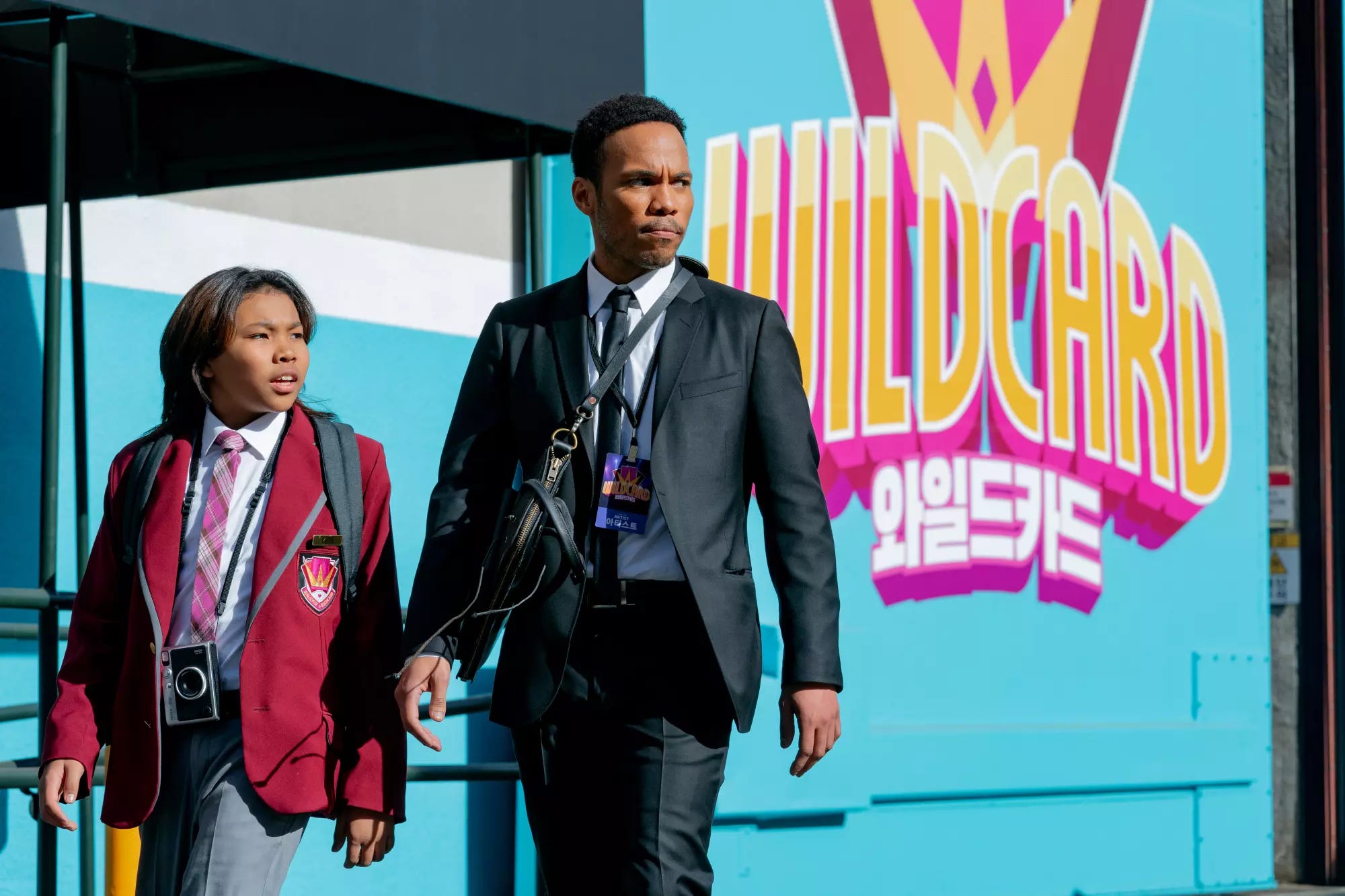
(Soul Rasheed and Anderson .Paak in ‘K-Pops!’. Photo credit: Jake Giles Netter / Aura Entertainment)
Did you always grow up wanting to be a performer, and was K-pop one of the few avenues you thought you had to take?
Yeah. For me, I come from a musical background. My uncle is an opera singer. My dad plays various instruments. He plays the piano, guitar and he loves singing himself. One of my earliest memories was just singing gospel songs with him at home in the living room. That then inspired me to become the praise leader at my local church in the Bay Area and being in the school choir. Singing in front of audiences, that’s something I really found a passion for. But because I didn’t see myself in American media, there’s no way I could pursue what I want to do out here.
At the time, my mom was watching a lot of K-dramas on VHS tapes. Sometimes, they’d have tape left over from Korean music shows like Music Bank and Inkigayo. This was during the first generation of K-pop, when acts like BoA was around, g.o.d., Shinhwa, Rain…just to list a few of my favourite K-pop idols back then. That was when I really got obsessed with it.
YouTube wasn’t around back then, so I had to go to the Korean CD stores and buy the physical CDs and cassette tapes. I feel old talking about this right now (laughs) but, yeah, that was just my joy in life.
After school, I would run home and watch those DVDs and tapes and just really picture myself being one of them on stage. So I begged my mom to audition for all the major agencies like JYP and SM. There were a few auditions being held in San Francisco and LA, so I went to those. And then I went to Korea that year to audition. The rest is history.
You were in K-pop at a time when there weren’t that many Americans or Canadians in the industry. But now it has changed a lot. What’s it like seeing the cultural shift in K-pop?
Nowadays, it’s mandatory to have a foreign member in a group, whether they’re American, Canadian or Japanese or another culture. But back then, it was really rare to have an English speaking member in the group. You had Jessica and Tiffany from Girls Generation, Jay Park or Amber from f(x). A lot of Koreans didn’t know the struggles we went through as a foreigner in Korea. They didn’t really understand us on a deeper level. So there was no other choice but to have a really strong bond between all of us second generation English speaking idols. There was really no one else to turn to. We’re still close to this day.
How difficult was it to step away from U-KISS in 2017?
It was one of the hardest decisions of my life. You know, I was debating and contemplating for a long time. I really felt like a strong bond with the members. It’s like family. We just knew everything about each other because we’ve been training since we were kids and achieved so much together.
I was in the group for 10 years, and I was one of the original members. There were a lot of changes throughout the years. But as an OG member, I felt like I’ve done my duty. And coming from America, I’ve always envisioned myself going back to the States and pursuing arts, whether it was music or acting. I’ve always wanted to expand my horizons.
It was definitely a hard choice, and I had a heavy heart leaving the group. But getting a lot of support from my members really helped me transition smoothly out of the group and pursue my next chapter.
Did it feel like starting all over again when you moved back to the U.S.?
I was starting from square one, honestly. You don’t get any special treatment because you’re a K-pop star. No one really cares. They really care about your skill set. Especially as an Asian American, there’s more layers to us and less opportunities than the average American. I felt like I was really fighting for every opportunity that came my way and really proving my experience as an artist.
I know your trainee days were difficult. But in some ways did that help build that resilience to start over?
Oh, spot on. The resilience I have today all comes from the work ethic I’ve built in K-pop. Because I had to prove myself and fight for everything, that’s really my driving force when it comes to auditions and putting music out. It gives me so much more purpose in my life.
What roles would you like to try one day?
I was kind of the antagonist in K-Pops! so I kind of love this era for me. It’s definitely a side of me that fans have never really got to see. I would love to do romantic comedies and maybe some action. Also, a musical film.
What do you hope audiences can take away from K-Pops!
For the Asian community, I hope that their voices can be heard through this movie. It’s okay not to fit in a box. It’s an all-Asian cast and that in itself is so powerful. I hope we can uplift the community.
K-Pops! is out now in select theatres. Follow Kevin Woo on Instagram!
For more updates, follow bunni pop on Instagram, TikTok and Threads.