


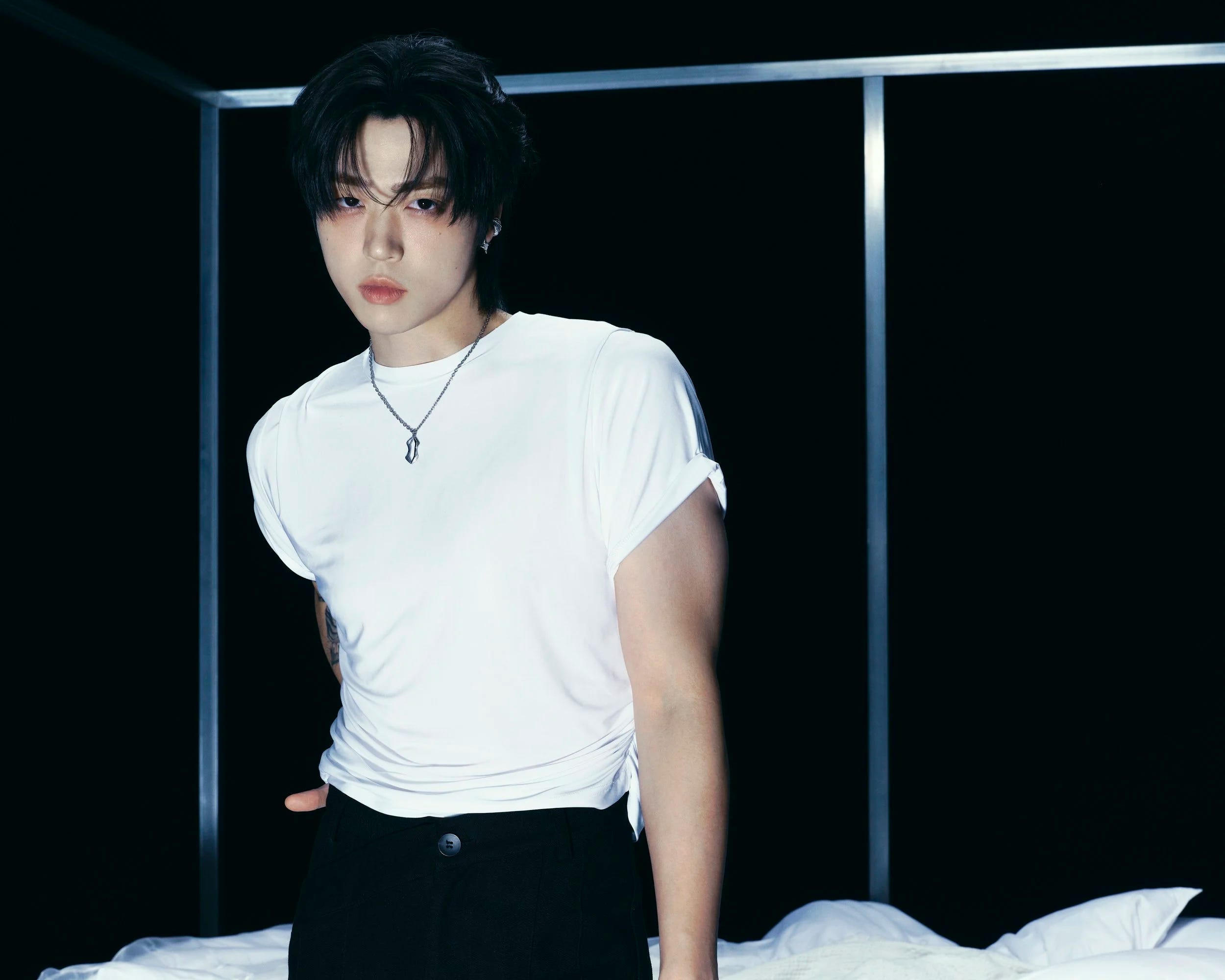
(Photo credit: Mauve Company)
Love is a complex feeling. At times, it’s exciting, intense and passionate. Other times, it can be fleeting, heartbreaking and confusing.
It’s exactly why Vancouver-born singer-songwriter JUNNY gravitates to writing about the emotion in his music. His 2022 debut album [blanc] explored coming of age in his 20s, with themes around relationships and breakups.
His 2024 EP dopamine delved into the rush of simmering romance. While his latest album [null]—released in August 2025—explores the ups and downs of a relationship from beginning, middle to end.
“Love is extreme. It makes you your best and worst version at the same time. When you’re in it, everything feels cinematic. When it ends, everything feels distorted,” JUNNY tells bunni pop in an interview.
“That emotional contrast is addictive as a writer. I’m always chasing honesty, even if it makes me look vulnerable—especially if it does.”
In February, JUNNY is heading back on the road as part of his North American [null] tour, which will see him make stops in Montreal, Toronto, Calgary and his hometown of Vancouver.
Below, he shares a bit more about his songwriting process, his musical inspirations and shares his advice to aspiring singer-songwriters.
Interview has been edited and condensed for clarity.
Hi JUNNY, you’re about to head back on the road on tour. These are rare moments to return to your home country of Canada. What do you miss most about your hometown Vancouver?
I miss how quiet it is.
Vancouver isn’t loud in the way Seoul is. It’s grey, it rains, it feels slow, but that slowness is grounding. I miss driving by the water, the mountains just sitting there like they’ve seen everything. It’s the only place that still feels like I’m not “on.” I can just be [Kim] Hyeongjun there.
And what is the thing you’re most looking forward to doing once back in Canada?
Honestly, just eating and seeing my family. Nothing glamorous.
I want food [from home], I want to see my friends I grew up with, the people who knew me before music. There’s something about being around people who don’t care about what you’ve done. They just care if you’re okay. That reset is important before going back on tour.
Your latest album [null] is one of your most experimental projects yet. What was the story and journey you were exploring while making this album?
[null] is about emotional reset. It starts almost like a dream. Soft, hopeful, romantic. And then it slowly unravels. It goes through infatuation, dependency, tension, silence, and eventually collapse.
I was exploring what happens when love becomes something you can’t hold onto anymore. [Null] felt like the right word because it’s not just empty. It’s the space after something disappears. It’s that quiet after the impact.
Can you tell me a bit about the production of this album, because some of the tracks like “No Morning” are quite minimal and quiet. While other songs like “Passion, Pain, Pleasure” are louder and intense in feeling. How did these two tracks capture what you were trying to convey?
“No Morning” feels like the epilogue. It’s what’s left after everything already happened. It’s quiet, stripped back, almost weightless. There’s no fight left in it. Just acceptance. I wanted it minimal so it feels like you’re sitting alone with the aftermath. It’s the emotional residue of the relationship.
“Passion, Pain, Pleasure” is like rewinding the tape. It takes you back to the very beginning, when everything was intense and magnetic. The chemistry, the obsession, the fire. Sonically, it had to feel bigger and overwhelming because that’s how it starts. Loud, consuming, almost reckless.
What were some of the artists and songs you were listening to while you were creating this project?
A lot of R&B, old and new—Frank Ocean, Dijon, Daniel Caesar. Some alternative stuff too. I was listening more for texture than structure.
I wasn’t trying to copy anything, but I was studying feeling, how minimal production can still feel massive emotionally.
Colde and Seori feature as artists in this project. What was it like to work with them?
They’re both very intentional artists. Colde has this calm precision. He doesn’t waste notes. Seori brings this emotional fragility that feels cinematic. With both of them, it wasn’t forced. It felt like we were building atmosphere more than just making songs. That’s when collaboration feels right.
You have written for some of the biggest artists in the K-pop industry, including IU, Kai and NCT. How have these experiences shaped the way you approach music-making these days?
It taught me discipline. When you’re writing for artists at that level, you have to respect identity. You can’t just write what you would say. You have to step into someone else’s world.
It sharpened my instincts. Now when I make my own music, I’m more intentional. I know when to edit. I know when to leave space.

(Photo credit: Mauve Company)
There was a time when not many Asian Canadians could be seen in the music industry. Do you think that’s changing?
Yeah, definitely. Growing up, it wasn’t common to see someone who looked like me in Western pop spaces. Now it’s expanding. It’s not perfect, but it’s moving.
I think the biggest change is that we’re not being boxed into one lane anymore. We don’t have to represent Asian music. We can just represent ourselves.
Many of your early songs got discovered on Soundcloud and social media. Do you see the role of social media as beneficial? Or is it a bit of a double-edged sword these days with the pressure to go viral?
Both. It gave me a career. SoundCloud and YouTube are how people found me, so I’ll never ignore that. But now there’s pressure to perform constantly. To go viral. To be visible. That part can distract from actually creating.
I try to treat it like a tool, not an identity.
What is your advice to aspiring songwriters and artists in Canada right now?
Don’t wait for permission. You don’t need to move cities or know the right people to start. Just make the music. Release it. Improve publicly.
Be patient. Real growth isn’t viral. It’s consistent.
JUNNY plays in Toronto on February 17 at Phoenix Concert Theatre. Buy tickets here!
Follow JUNNY on Instagram!
For more updates, follow bunni pop on Instagram, TikTok and Threads.
Such an underrated artist. Thank you for another great article!