


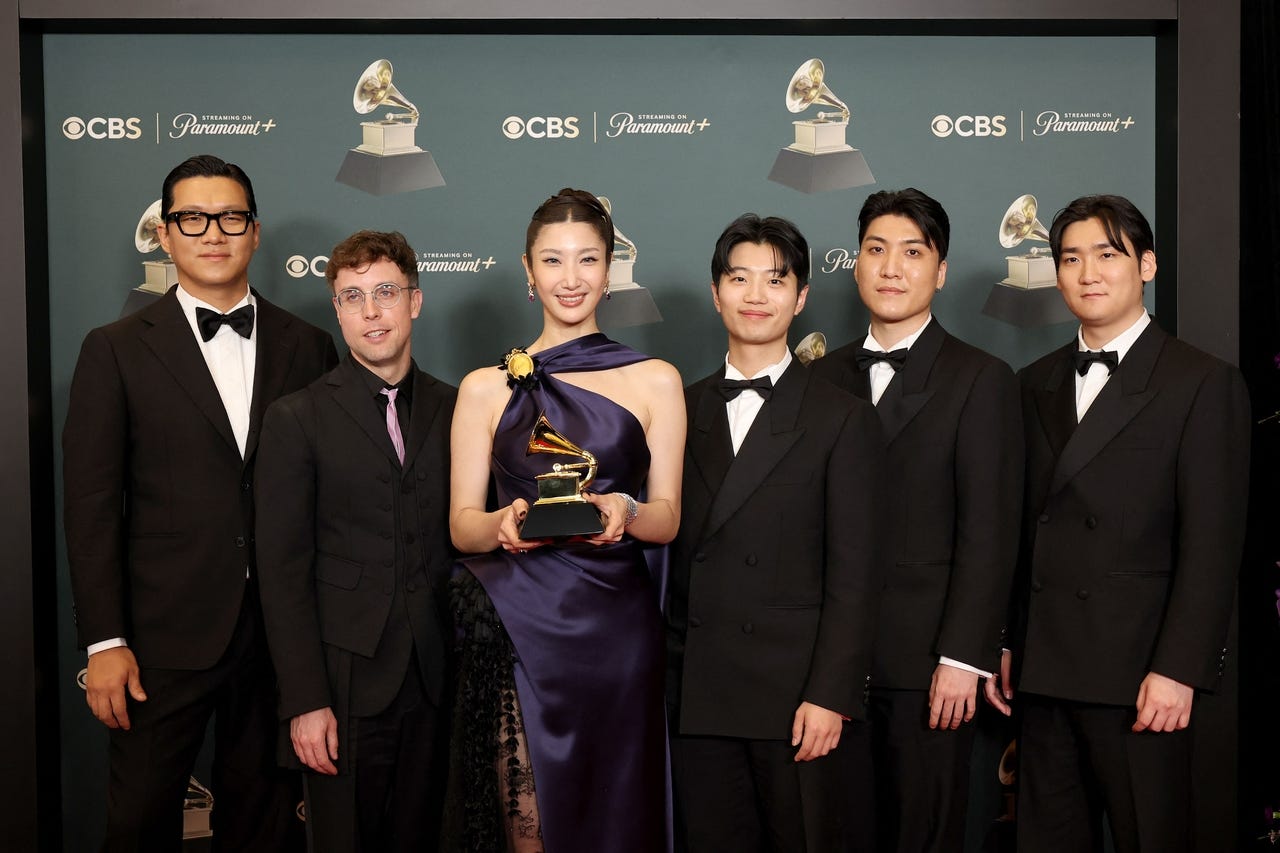
(Photo credit: AFP)
K-pop made history at the Grammy Awards on Sunday. “Golden”, the hit song from the KPop Demon Hunters soundtrack, took home a trophy for Best Song Written for Visual Media.
Still, a debate emerged throughout the night amongst K-pop fans. Can “Golden” be considered a real K-pop song?
Unlike groups with loyal fandoms like BTS and Blackpink, “Golden” is sung by a fictional animated girl group called HUNTR/X with almost entirely English lyrics. And while EJAE, Audrey Nuna and Rei Ami have performed the song live, many fans still view “Golden” as detached from K-pop as a whole because they are not a real idol group. Rather, “Golden” and HUNTR/X borrow heavily from K-pop aesthetics and storytelling.
I’d argue that “Golden” is still K-pop, as it is produced and written by K-pop songwriters and producers. EJAE has an already impressive roster writing hits for the likes of Red Velvet, aespa and Twice. While The Black Label, which co-produced the KPop Demon Hunters soundtrack, is behind acts like MEOVV, Allday Project and Blackpink’s ROSÉ. Teddy Park, the founder of The Black Label, is also the first K-pop CEO to win a Grammy Award.
Still, I can see why many are debating over what qualifies as “K-pop” anymore. That’s because the genre has increasingly become harder to define in recent years.
If we go back to the 1990s, K-pop as a genre has always been influenced by the west, when H.O.T. (largely considered the first modern K-pop idol group formed under the trainee system) came onto the scene.
Genres like R&B, dance pop and hip hop have long formed the makings of K-pop songs inspired by groups like Boyz II Men and TLC. But what made K-pop distinct was its ability to mishmash genres all while catering to an audience back in Korea, featuring primarily Korean lyrics.
In recent years, that has changed as global audiences started to embrace K-pop music. There’s been a shift away from Korean lyrics, with many idol groups releasing all-English songs.
“Dynamite”, which made BTS the first Korean pop act to be nominated for a Grammy in 2021, did not have any Korean lyrics at all. Now in 2026, it would be unusual for any K-pop act NOT to release an all-English song. Of course, the business case in doing so is to increase the marketability of K-pop for global audiences. But at the same time, it’s also alienating audiences back home in South Korea.
According to The Korea Times, K-pop’s presence in the domestic market appears to be weakening, with some observers stopping short of calling it a “crisis.” Album sales have dropped at home, while exports of physical albums have also slowed in major markets. Experts who spoke to the Times also believe the K-pop industry’s rapid expansion has made it less flexible and less dynamic.
Even K-pop songs are largely written by those outside of Korea, with producers and writers like Dem Jointz and Jenna Andrews penning many K-pop hits. Several of the tracks sung by hit groups like NCT and Red Velvet often start from songwriting camps that bring artists from around the world to create music. In fact, NewJeans’ critically acclaimed EP Get Up was primarily written by Danish singer-songwriter Erika de Casier. It’s this global collaboration within K-pop that makes its sound more challenging to define.
Given the fast-paced evolution of K-pop in recent years, I don’t entirely blame people’s confusion with the genre if they’re just diving in. And with people questioning whether it’s time to give an award for “Best K-pop Album of the Year” at the Grammys…how does one define it? Many songs are primarily in English already. Many writers and producers also come from outside of Korea.
No matter the result, the 68th Grammy Awards was already going to be a historic year in K-pop with acts like ROSÉ, the singers behind KPop Demon Hunters and KATSEYE (a global girl group inspired by K-pop) landing nominations in major categories.
The Grammys is by no means a perfect organization, and could do way better when it comes to diversity. But last night’s awards show suggested to me that K-pop might have to find a clearer picture of its roots if big western awards is the genre’s and industry’s focus.
By the night’s end, the sole Grammy win for “Golden” was the only award K-pop took home overall.
Don’t get me wrong, I still think it’s a major breakthrough for K-pop. But might chasing validation from the Grammy organization be counterproductive for the K-pop industry as a whole?
See me elsewhere

In the spirit of awards season, I will continue to talk about the Canadian success story that is KPop Demon Hunters!
From Domee Shi to Maggie Kang, Oakville, Ont.’s Sheridan College has history of producing award-winning animators. Now the two directors are each nominated for Oscars. I visited campus to hear from animation students about their own dreams in filmmaking.
For more updates, follow bunni pop on Instagram, TikTok and Threads.
Rap was once considered black only music. Then it crossed over into the mainstream and you even have Korean rappers. K-pop is currently jumping into the mainstream just like rap and hip hop did. KATSEYE is proof of that. The truth is it’s almost done, and K-pop will soon only represent the style of music, not who sings it. Like example of Lisa makes a solo Kpop album, it’s still K-pop, even if she is from Thailand.
Interesting discussion!