


(Photo credit: Netflix/Rachel Simpson)
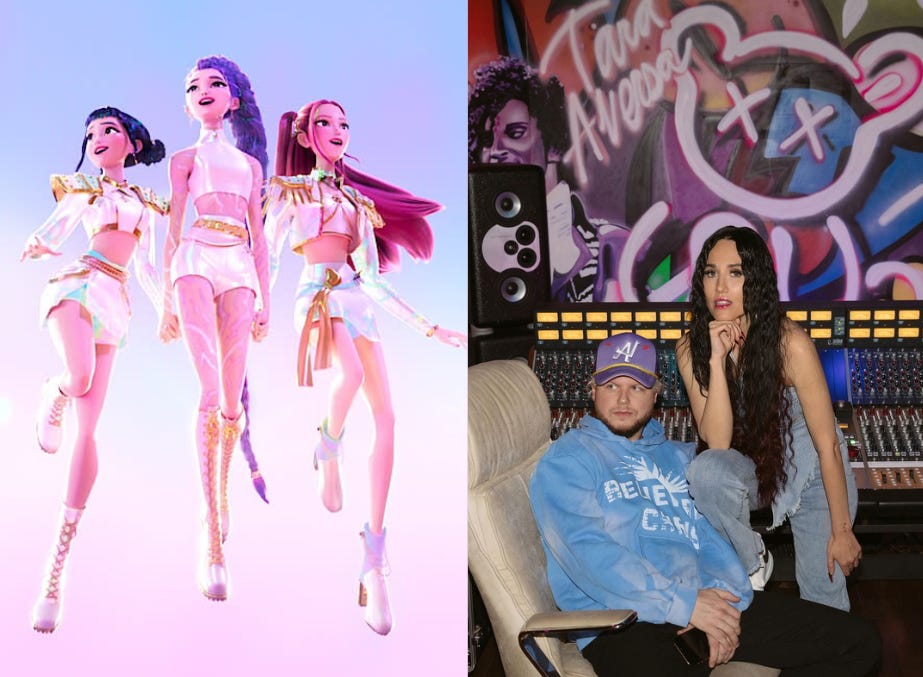
KPop Demon Hunters just keeps going up up up…and the breakout stars of the year happen to be two fictional bands known as HUNTR/X and the Saja Boys.
With five Grammy nominations and three Golden Globe nods, the animated film created by Toronto’s Maggie Kang continues to dominate our television screens and the music charts.
Since KPop Demon Hunters released on Netflix in June, it has become the streaming platform’s most successful original film. Though the project continues to break even bigger records musically. The soundtrack for the film spent two weeks at #1 on the Billboard 200 in September and October. “Golden”, which has since been shortlisted for Best Original Song for the 98th Academy Awards, has stayed on the Billboard Hot 100 for at least 25 weeks.
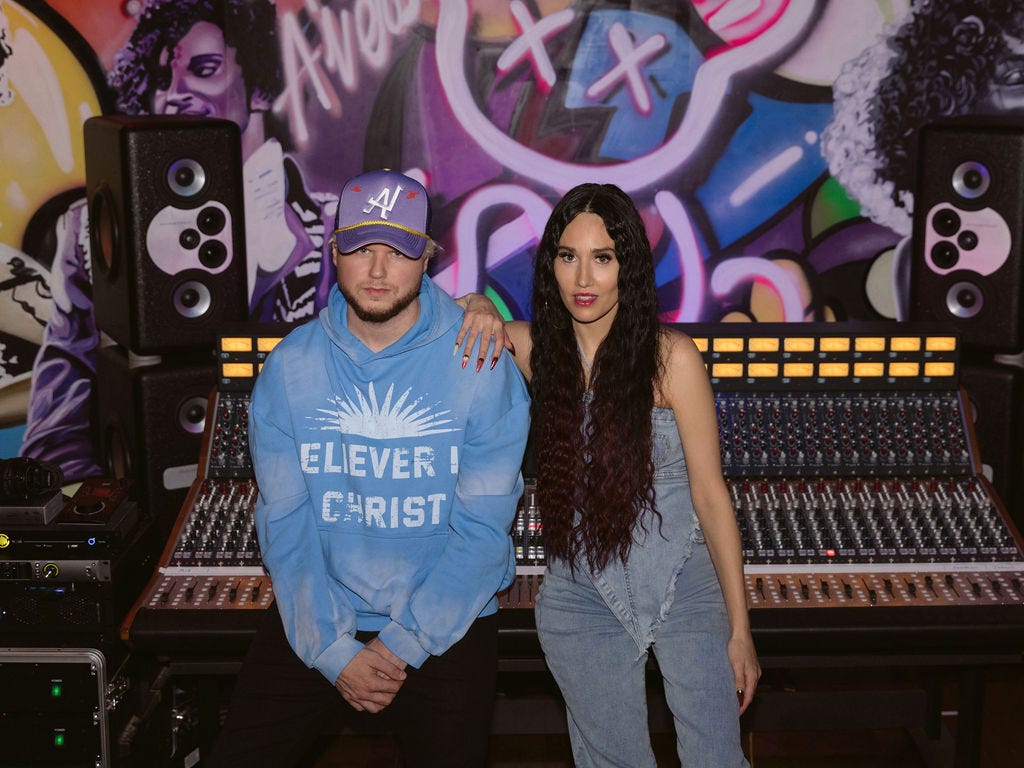
Two of the songwriters responsible for making the critically-acclaimed hits featured on KPop Demon Hunters’ soundtrack is Jenna Andrews (who hails from Calgary!) and Stephen Kirk. The pair co-wrote “Free” and “What it Sounds Like”—two tracks that come at critical points in the film.
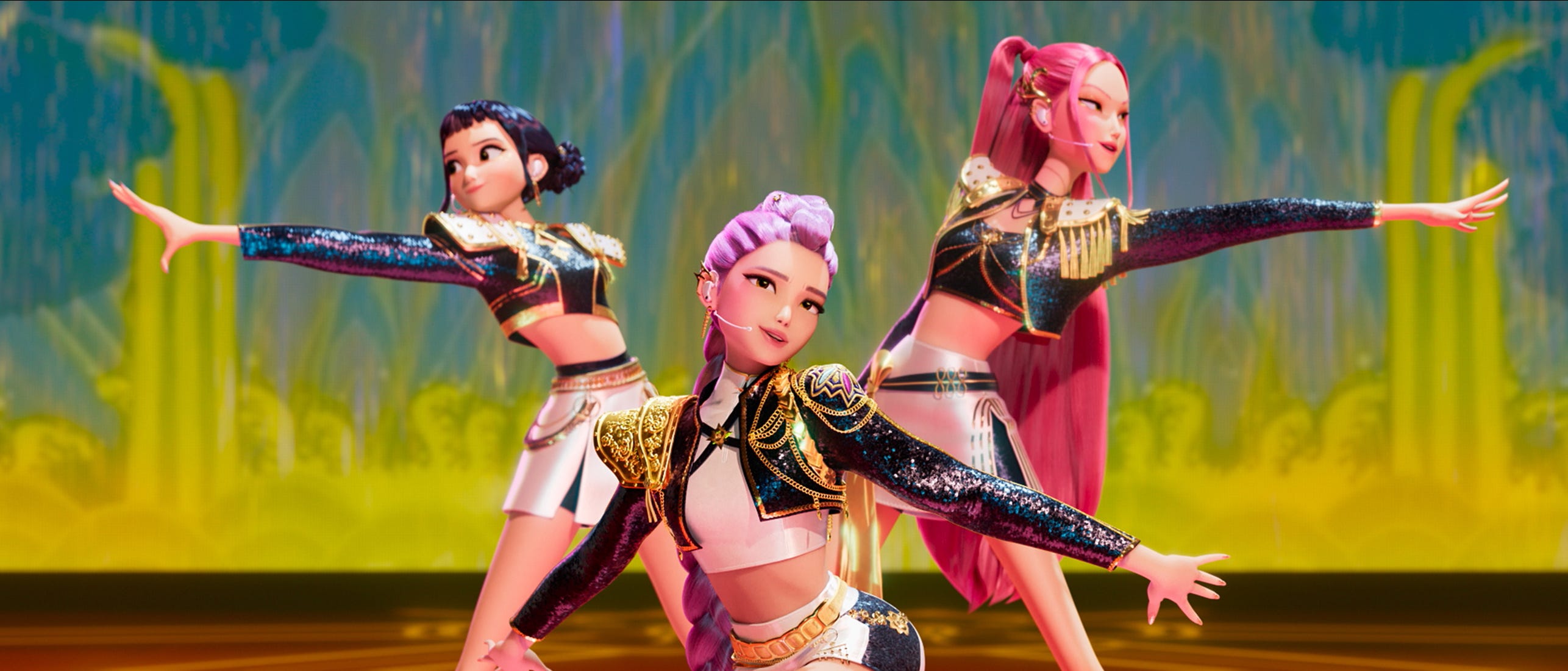
“Free” is an emotional ballad that sees protagonist and HUNTR/X front woman Rumi singing a duet with Jinu, the conflicted leader of Saja Boys, about their deepest secrets. Meanwhile, “What it Sounds Like” serves as the epic finale of the film.
Partners in life and making music, Andrews and Kirk have also co-written tracks for the likes of BTS, Nelly Furtado, Mickey Guyton and Rita Ora. Below, Andrews and Kirk chat with bunni pop about the process of writing songs for KPop Demon Hunters and reflect on the film’s lasting impact.
Conversation has been edited and condensed for clarity.
This movie continues to just go higher and higher, and now has five Grammy nominations. How have you both been reflecting on the experience?
Jenna Andrews: It’s just such a blessing. Honestly, it’s just been such a cool ride for us this year, and just so amazing to be a part of.
How were you approached to take part in the film and write music for it?
Andrews: Spring Aspers, who’s the head of film at Sony Pictures actually hit us up around two years ago, and essentially they were still in the very beginning of the animation. I know they really wanted to find people that were already really working a lot in K-pop and have that authenticity attached to the film with the music. Obviously, we were so excited to be a part of it. That’s really how it started. It’s been over a two year process.
Did either of you have much knowledge of what the story was going to be when they approached you?
Stephen Kirk: We didn’t have any idea about the story or the characters when we were approached. But I think throughout the process, we didn’t know a lot, but we started to understand the baseline of the story which helped a lot.
We would have a hand drawn sketch of what was to be in the scene. And then we got…an explanation of what the characters were feeling or needing in the scene. Ian Eisendrath (music supervisor for KPop Demon Hunters) really helped us shape the songs and turn them into what they are.
(Photo credit: Netflix)
Both of the songs you wrote for this film come at critical points of the story. I want to begin with “Free.” What was the process like creating that ballad?
Andrews: I mean, honestly, “Free” was one of the first songs that they worked on for the movie, which was really cool.
And again, we had a brief, so we kind of understood what the scene was trying to be. They give you references of songs they wanted it to sound like. That song actually came the easiest. When we did that song and we sent it in, they loved it immediately.
“What it Sounds Like” came after, but I‘m not sure you saw…that [song] definitely [took] 147 versions.
What songs were used as inspiration to write “Free” ? Many of my friends thought of Disney while listening to it.
Kirk: Melodically, definitely. Musically, there wasn’t much inspiration. When we saw the colour palette of what the scene was going to be, it kind of just gave me a sound for what I wanted the track to sound like.
Melodically, when it goes to the post-chorus, it definitely feels more Disney because Disney songs really have a magic to them. They make you feel like you’re levitating. Throughout the song, it constantly kind of builds into that. And then every time the post-chorus comes, it just adds another element of like, etherealness.
Moving to “What it Sounds Like,” I cannot tell you how loud everyone screamed the moment that song started playing inside the theatre when I watched a screening of the film. Jenna mentioned it took 147 versions. What did it take to nail it?
Kirk: Yeah, I don’t think we’ve told anybody this, but we were tasked with writing the song that became “Golden”, and we were in the middle of that and going back and forth on revisions for that. And then we got a call that was like, “Hey, we need you to hop off this song and start the finale now. It’s gonna be pretty labour intensive.”
When we were working on it, we had no idea, but the scene kept changing. The animation kept changing, and then the ending kept changing. Then there was so much time added, and then time taken away, and then time added with so many revisions.
I mean, that was like a proper two year process for that song. It was probably the most challenging thing that I’ve been a part of musically, just because of how perfect it needs to be for a moment like that. Every time the movie would change, the song has to change. So we really struggled with that one, but not in a bad way. It was just a really hard earned victory for us.
(Photo credit: Netflix)
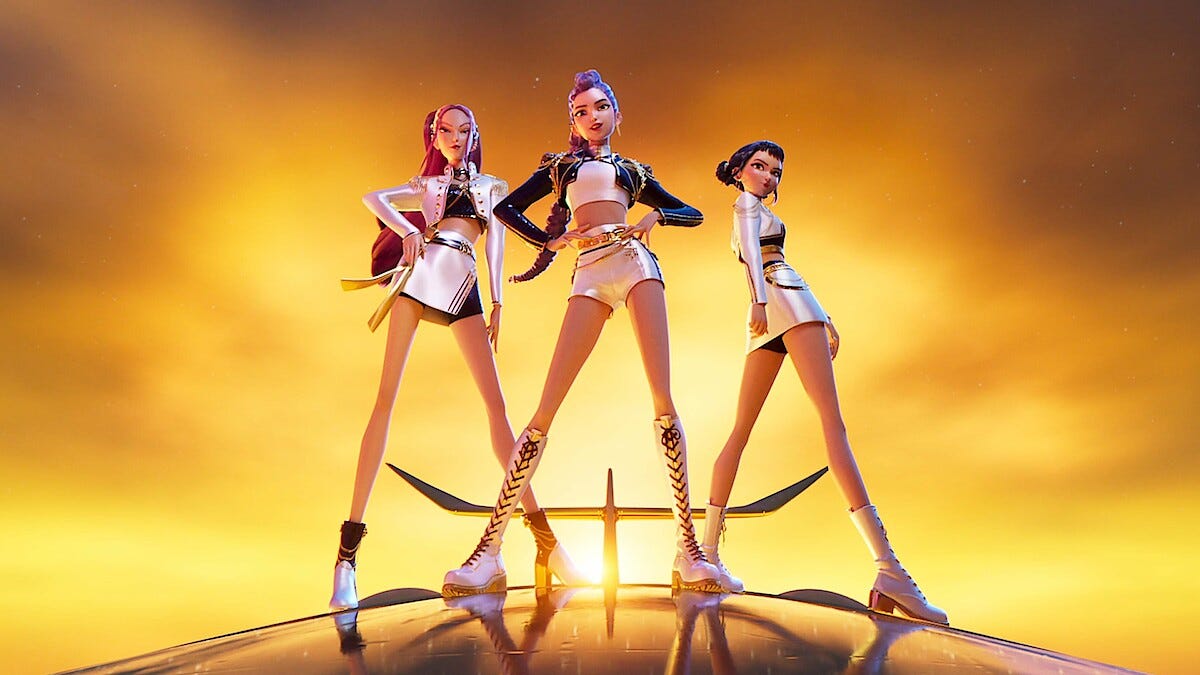
This really comes at the climax of the film. How did you nail the epic-ness of it?
Kirk: I was in a rock band for a long time with my brother. So when [HUNTR/X] were on stage interacting with the crowd, I knew what the scene was going to be. Personally, I wanted big guitars. I wanted massive drums to make it feel like you were in an arena. The song sounds exciting and big, because it’s a blend between what a pop song would be, but then what you would hear at a rock concert in an arena.
For the movie’s sake, we put strings in it because it gives it a cinematic feel. So there’s just a lot of elements that pull on human emotions and heartstrings in the music to lift the song to where it is.
What was it like to see the final product on screen?
Andrews: Oh my god, it was so cool! It’s emotional. It’s amazing. It’s just beautiful.
Kirk: It was definitely rewarding. Being able to see the movie and see the vision of the animators and the directors and the writers and the producers alongside the music was just such a blessing. It was just so fire.
Andrews: We got to see the sketches along the way. I think being able to see the actual movie after it had been built up little by little, it’s just so cool to see it come all the way to life.
Both of you are involved in all types of music, including K-pop. But this film really catapulted the genre in ways we haven’t seen before. What do you think KPop Demon Hunters does for the genre?
Kirk: It’s just a global genre anyway, but I think little kids can access K-pop now without having to find a favourite band yet—unless your favourite band is HUNTR/X or Saja Boys!
People hate the most popular things in the world who are like, “Oh, I won’t listen to BTS, or I won’t listen to KATSEYE, or I won’t listen to Blackpink” because it’s the popular thing to do. But I think this movie kind of took the world by storm because it played at different emotions like self-acceptance, and it really spoke to the heart.
I think parents and kids and grandparents and young adults all really felt like they could identify with this movie, which is based around K-pop.
We’re just really happy to be part of the culture and the genre.
You were both involved in composing “Butter” by BTS, which was recognized with a Grammy nomination in 2022. Can you tell me what that experience was like?
Andrews: Oh my gosh! It was so cool because they were coming off of “Dynamite”, which was their first real English song. It was so cool to be able to be [involved] with “Butter” and “Permission to Dance” following that. I think it really did define BTS in the United States specifically because they’d already been so massive globally. That was such a cool thing to be a part of, honestly!
Jenna, you grew up in Calgary. Was making big hits the path you imagined for yourself? I think a lot of people often think of Canada as a small country.
Andrews: I know they really do! It’s crazy…specifically Calgary.
I’ve always been a big dreamer. I think for me, I started out being an artist. As a kid, that’s what I thought my path would be. Becoming more behind-the-scenes in writing for other artists and being part of projects like this was definitely not something I thought of as a kid.
I think it’s opening up the world now for kids to think of [songwriting] as a career choice. I just think naturally as a kid, especially when I was growing up, if you want to do music or you sang, the artist path made sense. But now, there’s a lot more people that hit us up and know about the work we’ve done behind-the-scenes which is really cool.
(Photo credit: Rachel Simpson)
You’re not only songwriting partners. But also partners in life. What’s the balance between musical and romantic compatibility?
Kirk: Everything that she believes in, everything she loves, Jen is an amazing, amazing, amazing woman in so many different ways. But with all of those amazing characteristics comes a woman who has struggled and fought to be where she is and has sharpened her. When she steps into the studio, she is like a heavyweight boxer in a ring.
We don’t make songs just for the money or the recognition. We do it for the love of it. When you’re in the studio, there are times when it’s like 15 minutes in, everything’s perfect and easy. Then there are times where we’re struggling four or five hours on a line. There’s going to be tense moments.
It’s not about us, and how we’re feeling. It’s about trying to get to a common goal. The only real arguments that we have are always around music. It’s hilarious.
Andrews: It’s funny because when we first met on Zoom, even the creative process, it was just so inspiring to meet Stephen. He [has] just a different type of creative energy and talent. It was something that I was like, “Oh my gosh. This feels magical.” It started that way. We were creative partners for over a year before we even dated. That says a lot about our relationship as well, like where our souls are. I just think our synergetic energies are so connected, you know?
Going back to KPop Demon Hunters, what legacy do you think a film like this leaves behind?
Kirk: I think first of all, being nominated for a Grammy is just a blessing. But I think the real gift from this movie is that my sister and her daughter Penelope—when they talk to me about the songs—they both have different interpretations of what self-acceptance is because they’re at different places in their life.
This movie is based around accepting yourself for who you are, flaws and all. It’s understanding that you can’t be your ultimate truest form of self without embracing what makes you that.
I think this movie is really entertaining for a lot of reasons, but the message behind it is so powerful that I do believe that people will continue to watch it and continue to love it.
For more updates, follow bunni pop on Instagram, TikTok and Threads.